
What Pain Neuroscience Education Can Teach Us About Labour Pain
By: Ibukun Afolabi, Pelvic Health Physiotherapist, and Jasmine Brar, PT Student ∙ Estimated reading time: 9 minutes
By: Ibukun Afolabi, Pelvic Health Physiotherapist, and Jasmine Brar, PT Student ∙ Estimated reading time: 9 minutes
The Stories We Bring Into the Birth Room
The first birth Ibukun (Ibbie) Afolabi ever attended was in Uganda, when she was a physiotherapy student. She walked into the room braced for screaming. As far as she knew, that's what birth sounded like.
The mother made no sound.
Ibbie later learned that in this mother's community, women weren't expected to show pain or weakness in labour. She was simply following a different script than the one Ibbie had grown with.
If you work in pelvic health, you already know why that matters. Pain isn't a readout of what's happening in the tissue. As the IASP's 2026 definition puts it, "pain and nociception are different phenomena." Pain is the brain's best judgement about threat, built from sensation, memory, culture, and expectation. It's the heart of pain neuroscience education, and you teach it every day to people with persistent pelvic pain.
We know labour pain is biopsychosocial too. So why do so many prenatal conversations still start and end with the epidural?

She never mentions pain. Pain answers anyway.

The Epidural Question
Today, Ibbie is a pelvic health physiotherapist with a prenatal practice. She asks pregnant clients an open question: what's your vision for your birth? She estimates that around 95% answer by talking about the epidural, whether they want one or not. She never mentions pain. Pain answers anyway.
It's not surprising. People arrive with years of stories: a parent's account, a friend's warning, a dramatic TV delivery, the throwaway line "worse than giving birth!"
Even our kindest advice adds to the pile. "Just get the epidural. No need to be a superhero" is meant to take the pressure off. Underneath, it assumes birth will be unbearable.
The brain hears all of it. It's always predicting what's coming, and those predictions shape what it eventually feels.
Labour Is a Unique Kind of Pain
This is what makes labour such an interesting case for pain science. Most of the pain we treat is protective: a signal that something may need defending. In physiological labour, the sensations mean something else entirely. Contractions are the uterus doing its job. They have a purpose, they come and go with rest in between, and for most people they have a clear end point. (Pain that's constant, or that doesn't ease between contractions, is a different story and needs assessment.)
The nervous system doesn't automatically know any of that. Feed it fear, and it responds the way it would to any threat.
Adrenaline rises.
The jaw, pelvic floor, and abdomen tighten.
Pain perception climbs.
And because adrenaline works against oxytocin, the hormone that drives contractions, labour itself can become less efficient. Childbirth educators have long called this the fear-tension-pain cycle.
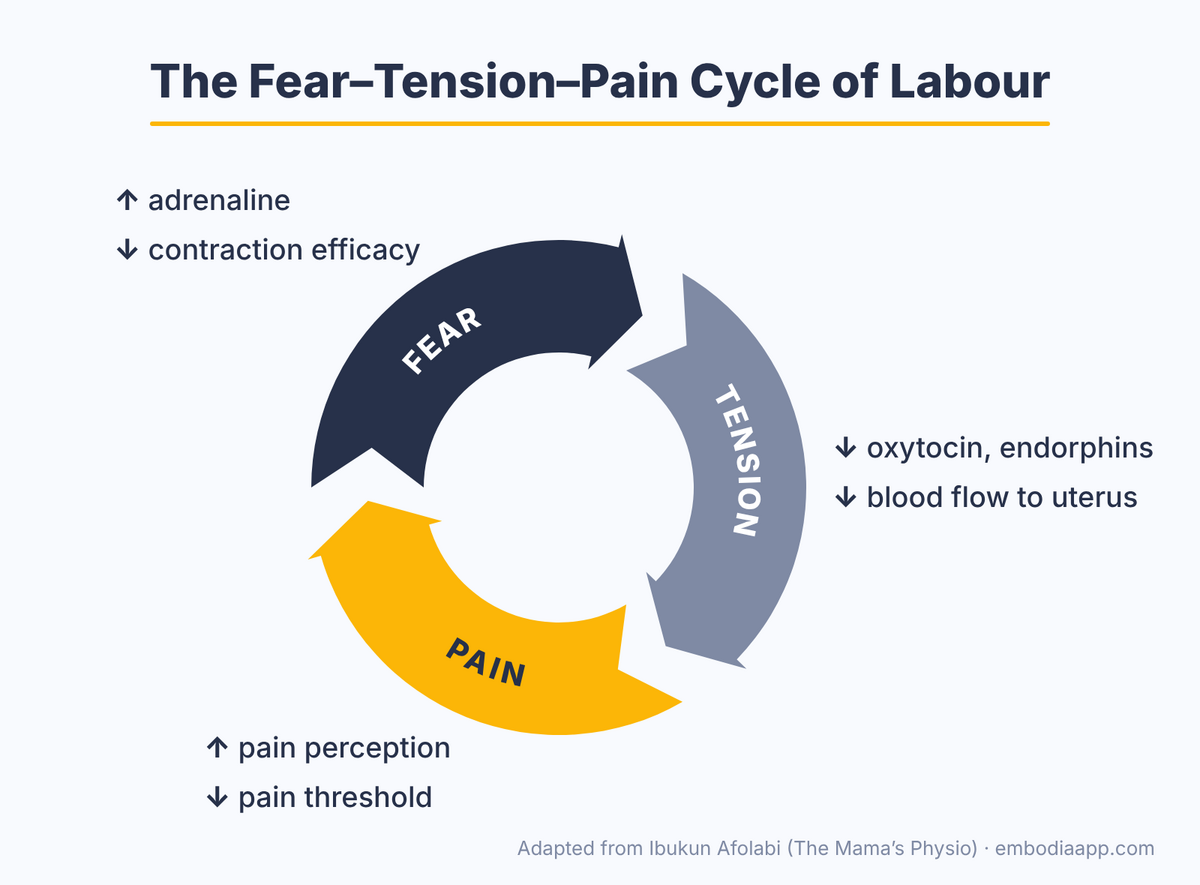
The reverse holds too. Oxytocin flows best when people feel safe, warm, relaxed, and unobserved, and endorphins rise through labour as the body's own painkillers. Touch, water, movement, breath, focus, and continuous support all act on the body's pain-modulating systems.
None of this is foreign to you. It's the same dimmer switch you already teach in pain neuroscience education, pointed at a different kind of pain.
What People Actually Remember
Here's the findings that should change how we prepare people for birth. When women look back, pain matters less than you'd think. A systematic review by Hodnett (2002) found that four things shaped how women judged their birth experience more than pain or pain relief did:
- Their personal expectations
- Support from caregivers
- The quality of the caregiver relationship
- Their involvement in decision-making
Every one of those is something we influence.
This isn't an argument against epidurals. Pain and suffering aren't the same thing. Labour pain can often be coped with; suffering needs to be prevented. And you can't tell one from the other by sounds or movement alone. So ask, offer options, and make space for people to request relief, with physiological support continuing despite what they choose.
Every client arrives with a script for birth. What we say before labour helps write it.
A Better First Question
So back to that intake question. What if, instead of starting with pain or pain relief, we asked: "How do you want to feel during your birth?"
It's a small change. It invites people to imagine something beyond getting through the contractions, and it opens the door to everything you already know about how the brain makes pain. Ask early, ideally in the second trimester, and there's time to practice the tools before they're needed.
Every client arrives with a script for birth. What we say before labour helps write it.
Learn The Full Approach
Ibbie presented Using Pain Neuroscience Education in Labour and Delivery on October 7, 2027, as part of My Year of Mentorship 2027: Building a Practical Pelvic Health Playbook with Carolyn Vandyken. The session covers what this post only touches on: the screening tools she uses with prenatal clients, how she explains pain in a birth context, and the strategies she teaches before labour begins.
It's one of 20 live sessions running January to December 2027, with recordings, monthly office hours, a learning partner, and a forum shared with past cohorts. Joining with a colleague? You'll each save 25%.
Registration is now open, with early-tier pricing for the first 20 seats. Learn more and register.
References
- International Association for the Study of Pain. IASP Announces Revised Definition of Pain, 2020.
- Hodnett ED. Pain and women's satisfaction with the experience of childbirth: a systematic review. American Journal of Obstetrics and Gynecology, 2002.

MScPT, BA(Hons.)Kin, PCES, CCE, CD
Ibukun is an Integrative Pelvic Health Physiotherapist whose passion lies at the intersection of women’s pelvic health and childbirth. She has been practicing as a registered physiotherapist since 2007 and the bulk of her career has been focused on serving pelvic and perinatal health population.
Ibukun is a certified childbirth educator, certified postpartum doula, and birth support physio/doula. She is an instructor with Doula Canada and Physio-Plus. Ibukun is a sought-after speaker and has offered training workshops for midwives, labour and delivery nurses, birthing families, and other health professionals. She is fascinated by the applications of pain neuroscience within the context of birth.